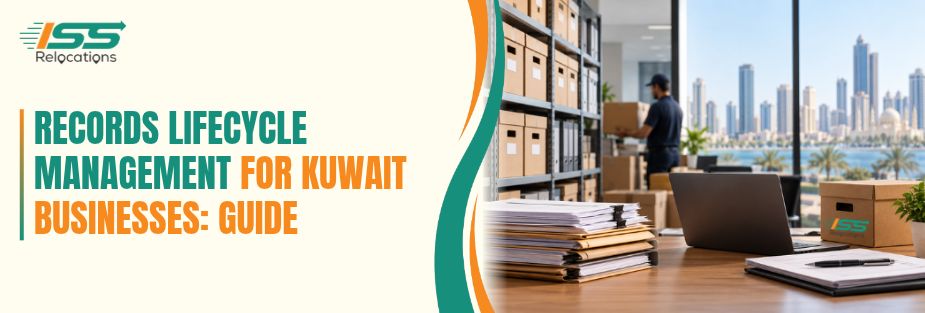
Records Lifecycle Management for Kuwait Businesses: Guide
Records lifecycle management helps Kuwait businesses control documents from the moment they are created until they are securely destroyed or permanently preserved.
Without a defined process, important records often end up spread across departments, personal workstations, filing cabinets, email inboxes, and rented storage areas, making them difficult to find and risky to retain.
For a business operating in Kuwait, the right approach must balance accessibility, confidentiality, continuity, space, cost, and applicable legal or sector requirements.
This guide explains how to build a practical lifecycle framework, assess document storage services, create a workable retention process, and manage secure document destruction without treating every document as if it should be kept forever.
Why Records Lifecycle Management Matters for Kuwait Businesses
Records are business assets, but they can also become a liability when they are unmanaged. A signed contract may be needed during a dispute, an employee file may be required for an internal review, and a finance record may need to be retrieved for an audit or official request.
If nobody knows where the record is, who can access it, or whether it is still reliable, the business carries unnecessary operational risk.
Records lifecycle management provides a controlled path for business information. It covers the creation or receipt of a record, classification, use, storage, review, retention, and final disposal or preservation. The objective is not to keep every document permanently.
It is to retain the right records for an appropriate period, protect them while they have value, and dispose of them safely when there is no continuing business, legal, regulatory, or historical reason to keep them.
The Cost of Keeping Everything
When planning records lifecycle management, a common pattern we see in business moves and office transitions is the accumulation of records over many years. Old supplier invoices are mixed with current contracts.
Former employee files remain in active cabinets. Duplicate project folders occupy valuable space. Nobody wants to authorise disposal because the company cannot distinguish essential records from duplicates or outdated copies.
Keeping everything may feel cautious, but it creates several problems:
- Retrieval becomes slower because staff must search through unnecessary material.
- Confidential information remains exposed for longer than necessary.
- Storage costs increase as inactive records take up office or warehouse space.
There is also a hidden cost: uncertainty. When teams cannot trust the completeness or status of a record, they may recreate documents, request information again, or make decisions without the full history.
Active, Inactive, and Vital Records
Active records are used regularly in daily operations. Examples may include current customer files, live contracts, ongoing project documentation, current HR records, and open procurement matters. As part of records lifecycle management, these records generally need convenient access, clear ownership, and appropriate permissions.
Inactive records are not needed every day but may still have business, legal, financial, or historical value. They can often be moved to controlled records storage services, provided they remain indexed and retrievable.
Vital records deserve additional attention because their loss could seriously disrupt the business. Depending on the organisation, these may include incorporation documents, key agreements, intellectual property records, insurance documentation, financial authorities, system recovery information, or records needed to re-establish operations after an incident.
The precise classification depends on the business and should be agreed by management rather than assumed.
Why This Matters During an Office Move
For records lifecycle management, an office relocation is a useful test of records discipline. When every cabinet is being opened and every box is being labelled, businesses often discover duplicate records, undocumented archives, missing files, and confidential information that has been left in unsuitable areas.
A move should not become an uncontrolled transfer of clutter from one site to another. It is an opportunity to identify what must move, what can be securely stored, what requires immediate access, and what is eligible for authorised disposal.
ISS Relocations can support the planning and coordination of office relocation and related document handling requirements where appropriate, while the business remains responsible for confirming its records, approvals, and applicable retention obligations.
Request Secure File Storage
Need more room for inactive files? Discuss organised off-site storage and retrieval arrangements for your business records in Kuwait.
How to Build a Practical Records Lifecycle Management Framework
A useful framework does not need to be complicated, but it must be specific enough for employees to follow. It should answer five practical questions: What records do we hold?
Who owns them? How long do we need them? Where should they be kept? What happens when the retention period ends?
The answers should reflect the organisation’s activities, risk profile, industry, contractual obligations, and applicable requirements in Kuwait and any other jurisdictions in which it operates. Requirements can vary considerably, so a retention schedule should be reviewed with appropriate legal, compliance, audit, or regulatory advisers where necessary.
Start With a Records Inventory
Before selecting storage or destruction services, create an inventory of the main record categories. Do not begin by counting boxes alone. As part of records lifecycle management, a box count shows volume, but it does not show sensitivity, ownership, retention value, or retrieval needs.
A practical inventory may group records into categories such as:
- Corporate governance, licences, ownership, and constitutional records.
- Finance, tax, procurement, contracts, and supplier records.
- HR, payroll, employee, recruitment, and benefits records.
- Customer, project, engineering, operational, and quality records.
For each category, record the department responsible, format, approximate volume, sensitivity, location, access level, and whether the records are active or inactive. Identify duplicates and convenience copies separately from official or master records. This distinction prevents the organisation from retaining several uncontrolled versions of the same information.
Define Ownership and Access
To make records lifecycle management reliable, every important record category should have an accountable owner. The owner may be a department head, records coordinator, compliance manager, or another designated role.
Ownership does not mean that one person personally manages every file. It means someone is responsible for approving classification, access, retention, and disposal decisions.
Access should follow business need and sensitivity. A current contract may be available to procurement and management, while employee medical information or disciplinary material requires much tighter controls. Storage providers and internal teams should have clear instructions about who may request, release, return, copy, or destroy a record.
When planning records lifecycle management, a strong process also records access events where appropriate. This becomes particularly valuable when the business needs to demonstrate who handled sensitive files or when a record was retrieved for an audit, investigation, or management decision.
Create a Retention Schedule, Not Just a Policy
When planning records lifecycle management, a document retention policy explains the organisation’s principles and responsibilities. A records retention policy goes further by defining how different categories of records are classified, protected, reviewed, and disposed of.
The terms are sometimes used interchangeably, but the quality of the operational schedule matters more than the title.
A retention schedule should normally identify the record category, responsible owner, retention trigger, retention period, storage location, access level, and disposal method. The trigger is important.
Retention may begin when a contract ends, an employee leaves, a project closes, a financial period finishes, or another defined event occurs. It should not automatically begin when a document is created unless that is appropriate for the category.
When reviewing records lifecycle management, a records retention policy template can provide a useful starting structure, but it should never be adopted without review.
A generic template may not reflect Kuwait requirements, a company’s contracts, industry rules, litigation risks, data protection responsibilities, or cross-border operations. Treat it as a working framework that must be adapted and approved.
Build Review and Hold Procedures
Retention periods are not permission to destroy automatically. Before disposal, the responsible owner should confirm that the record is not subject to a legal hold, investigation, audit, dispute, complaint, insurance matter, or unresolved operational requirement. The hold should suspend disposal until the authorised person confirms that it has been lifted.
To make records lifecycle management reliable, this control prevents one of the most serious records mistakes: destroying information at the scheduled date even though the business still has a reason to preserve it.
The review should also identify whether the record has been superseded, whether a complete official version exists, and whether any related records need to be retained together.
Get Records Storage Quote
Get a tailored quote for business records storage in Kuwait, with organised handling, inventory planning and convenient file retrieval.
Choosing Document Storage Services and Records Storage Services
Once a business has identified its records, it can make a more informed decision about where they should be kept.
Document storage services and records storage services are not simply about placing boxes in a room. The service must support security, identification, retrieval, accountability, and an orderly return or destruction process.
When planning records lifecycle management, the right option depends on the type of record, frequency of access, sensitivity, physical format, available office space, continuity needs, and budget.
A hybrid model is often practical: frequently used records remain on-site or in controlled digital systems, while inactive paper archives move to managed off-site storage.
Compare On-Site, Off-Site, Digital, and Hybrid Options
On-site storage offers convenience for frequently accessed records, but it consumes valuable space and may expose files to ordinary office risks such as unauthorised access, water damage, poor housekeeping, or accidental removal. It can work well when access is frequent and controls are strong.
When reviewing records lifecycle management, off-site storage can free up office space and provide a more structured archive. Businesses looking for a records storage service in Kuwait city and other cities of Kuwait should consider the provider’s document retrieval process, indexing system, security measures, handling procedures, and any associated charges or limitations. After all, storing records securely is only part of the responsibility; authorised employees must also be able to retrieve the right file when they need it.
The important question is not simply where the boxes are located; it is how confidently the business can retrieve the correct file when required.
When reviewing records lifecycle management, digital storage can improve searching and remote access, but scanning is not a complete solution by itself.
The organisation must consider image quality, indexing, version control, permissions, backups, system availability, and the status of the original paper record. Some records may need to remain in physical form or require specialist handling.
A hybrid approach can provide a practical balance. For example, a Kuwait-based company may keep current contracts and active HR records in controlled office or digital systems.
Transfer closed project files to indexed physical storage, and maintain approved destruction reviews for records that have reached the end of their useful life.
What to Check Before Appointing a Provider
When evaluating a records management services provider, ask for a clear explanation of how records are labelled, entered into inventory, stored, retrieved, returned, and eventually disposed of. To make records lifecycle management reliable, the provider should be able to explain responsibilities rather than relying on broad assurances.
Important areas to examine include:
- Security controls, restricted access, visitor procedures, and handling accountability.
- Environmental and physical protections suitable for the stored format and location.
- Inventory, barcode, indexing, retrieval, delivery, and return procedures.
- Business continuity arrangements and communication during incidents or service disruption.
- Disposal approvals, destruction records, and the process for placing a hold.
The contract should also clarify the service scope, request channels, response arrangements, charges, liability provisions, confidentiality responsibilities, and what happens when the agreement ends. These details matter because records may remain in storage for years, long after the original storage decision has been forgotten.
Prepare Records Before Storage
For records lifecycle management, do not send unsorted files to storage and expect the provider to create a reliable archive without agreed instructions. Before transfer, remove obvious duplicates, separate confidential categories where appropriate, confirm ownership, and use consistent box or file references. These steps become even more important when a business is moving to Kuwait, as records may need to be organised and transferred alongside office equipment, furniture, and other business assets.
To make records lifecycle management reliable, prepare a transfer list that connects each container to its contents at a useful level of detail. A label such as “Finance Box 12” may be insufficient if the business later needs a particular supplier contract.
A better description could identify the department, record category, date range, project or account reference, and sensitivity classification without exposing confidential information on the outside of the container.
At ISS Relocations, three decades of relocation experience have shown that labelling and chain-of-custody discipline are especially important when records are moved as part of an office relocation, consolidation, renovation, or storage programme.
With records lifecycle management, the business should approve the inventory and movement plan, while the relocation team coordinates the physical handling according to the agreed scope.
Design for Retrieval, Not Just Storage
A storage service succeeds when staff can locate the required record without repeated manual searching.
As part of records lifecycle management, decide how requests will be submitted, who can authorise them, how urgent requests are handled, how returned files are checked back in, and how missing or damaged items are escalated.
Test the process with several realistic requests before transferring a large archive. Ask for a current contract, a closed project file, an employee record, and a finance archive. If the team cannot identify the location or expected retrieval path, improve the index before committing the full collection.
Our moving experts are here to assist you.
Secure Document Destruction and the End of the Records Lifecycle
Destruction is the final stage of the lifecycle, not an informal housekeeping exercise. With records lifecycle management, secure document destruction should be authorised, traceable, and appropriate to the sensitivity and format of the records.
The purpose is to make information unreadable or irrecoverable through a controlled process, rather than merely removing it from an office.
The timing of destruction requires care. Retention schedules should guide review, but they do not replace judgement.
For records lifecycle management, a record may still be needed because of an audit, dispute, investigation, insurance matter, contractual obligation, official request, or operational dependency. When there is uncertainty, pause disposal and obtain appropriate internal or professional advice.
What a Document Destruction Policy Should Cover
A document destruction policy should define which records may be considered for disposal, who approves the decision, how holds are recorded, which destruction methods are permitted, and what evidence is retained.
As part of records lifecycle management, it should cover both paper and digital information, including copies held in working folders, systems, removable media, or other approved locations where relevant.
The policy should also explain how the business distinguishes an official record from a duplicate or convenience copy. It should state how exceptions are handled and how employees report records that may need preservation.
A short policy that people understand and follow is more effective than a lengthy document that does not reflect actual workflows.
Use an Approval and Destruction Register
Before destruction, prepare a register showing the record category, date range, owner, retention basis, proposed destruction date, approval, hold check, method, and completion evidence. The level of detail should match the organisation’s risk and compliance needs.
For confidential physical records, ordinary recycling or general waste is inappropriate because information may remain readable. With records lifecycle management, the chosen method should be suitable for the material and carried out through an authorised process.
Where a provider supplies confirmation or a certificate of destruction, retain it with the destruction register, subject to the organisation’s policy and applicable requirements.
Digital destruction also needs a defined process. Deleting a file from one folder may not remove versions, backups, shared copies, or system records.
The business should identify what can be deleted, who can authorise it, how retention holds affect deletion, and how the organisation records completion. Technical requirements vary by system, so specialist IT or information governance advice may be necessary.
Avoid Common Destruction Mistakes
One frequent mistake is destroying documents because they appear old without checking the retention trigger. For records lifecycle management, another is treating a storage provider’s scheduled disposal notice as automatic approval.
The provider can identify records that are approaching the agreed date, but the business must confirm that destruction is authorised and that no hold applies.
A further risk arises during office moves. Teams under pressure may place unwanted files in general waste skips or leave confidential boxes for contractors to clear. This creates an avoidable exposure at exactly the point when records are being handled by more people than usual.
When reviewing records lifecycle management, a disciplined process protects both the organisation and its service providers. It also creates a defensible explanation of what was destroyed, why it was destroyed, who approved it, and when the action occurred.
No destruction process can guarantee that every future question will be avoided, but proper controls significantly reduce uncertainty.
When ISS Relocations Can Support the Process
Businesses sometimes need records handled during an office move, branch closure, storage transition, refurbishment, or regional consolidation. With records lifecycle management, ISS Relocations can help coordinate the physical planning, packing, movement, storage arrangements, and related relocation requirements within the agreed scope.
This may be useful when records must be separated into active files, archive storage, and approved destruction streams.
The business remains responsible for classifying its records, confirming permissions, identifying holds, approving destruction, and verifying any legal or regulatory requirements. Clear instructions at the start allow the relocation team to handle the physical work efficiently without making decisions that belong to management, legal, compliance, or records owners.
Wrapping Up
Records lifecycle management gives Kuwait businesses a practical way to control information instead of allowing archives to grow without direction. The process begins with an inventory and clear ownership, continues through classification, access, retention, storage, and review, and ends with authorised preservation or secure destruction.
The most important decision is not whether to keep records on-site or off-site. It is whether the organisation can identify its records, protect sensitive information, retrieve the right file, suspend disposal when necessary, and demonstrate what happened at the end of the lifecycle.
Document storage services and records management services should support those controls rather than replace them.
Start by reviewing one high-volume or high-risk category, such as contracts, finance files, HR records, or closed project documents.
As part of records lifecycle management, map where the records are held, who owns them, how they are retrieved, and whether the current retention and destruction process is documented. From there, you can build a broader programme that suits your business, sector, locations, and operational priorities.
Where physical records need to be packed, transferred, stored, or managed during a Kuwait office relocation or wider business change, ISS Relocations can support the planning and coordination of the relevant relocation requirements.
A clear scope, approved inventory, and carefully reviewed retention process will help your organisation move forward with greater control and confidence.


- International Relocation
- Office Movers and Corporate Relocations
- Storage Services
- Mobility Services
- Pet Relocation
- Transit Insurance
- Local Moving Services
- Automobile Shipping
- Freight Forwarding
- Handyman Services
- Customs Clearance Services
- Records Management
- Hotel Fit Outs
- Third Party Logistics Services
- Bulk Cargo Services
- Baggage Services
"*" indicates required fields

FAQs - Records Lifecycle Management
What is records lifecycle management?
Records lifecycle management controls business information from creation and classification through use, storage, review, retention and authorised destruction or preservation.
Why do Kuwait businesses need a records retention policy?
A records retention policy assigns ownership, retention periods, access controls and disposal procedures. It helps reduce clutter and risk, but should be reviewed against applicable Kuwait requirements and industry obligations.
What is the difference between document storage services and records storage services?
Document storage services may focus on physical or digital document housing, while records storage services should also provide indexing, retrieval controls, retention support, accountability and approved disposal processes.
How should a business create a records retention policy template?
To make records lifecycle management reliable, begin with record categories, owners, retention triggers, periods, access levels, storage locations, review steps and disposal methods. Adapt any template to the organisation’s sector, contracts and applicable requirements.
When should a Kuwait business use secure document destruction?
When reviewing records lifecycle management, use secure document destruction after the approved retention period ends, the record owner authorises disposal, and no audit, dispute, investigation, official request or other preservation hold applies.
What should a document destruction policy include?
It should define eligible records, approval roles, legal-hold checks, permitted destruction methods, digital and paper procedures, evidence of completion, exceptions and responsibilities for employees and service providers.
Can ISS Relocations help with records management during an office move in Kuwait?
ISS Relocations can support agreed physical planning, packing, movement, storage and related relocation requirements. With records lifecycle management, the business must approve inventories, retention decisions, access permissions, destruction and applicable compliance obligations.
Moving Company - Recent Blog
Stay informed and prepared for your next move with our latest blogs on moving services in the UAE. From expert packing tips to international relocation guides, ISS Relocations brings you up-to-date insights to make your moving experience smoother, safer, and stress-free.


Our Membership & Affiliation