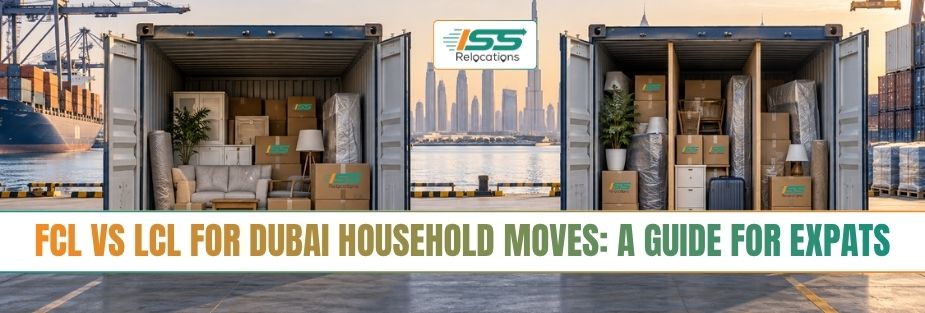
FCL vs LCL for Dubai Household Moves: A Guide for Expats
FCL vs LCL is one of the first decisions Dubai-based expatriates face when arranging international household goods shipping, and the cheaper-looking option is not always the most suitable one.
The right choice depends on how much you are moving, where it is going, how much handling your belongings can tolerate and how flexible your delivery plans are.
In this guide, we compare full container load and less than container load shipping in practical terms. You will learn how each option works, how quotations are built, which household situations suit each method and how experienced planning can help you avoid surprises before your belongings leave Dubai.
FCL vs LCL for Dubai Household Moves: What Is the Difference?
FCL and LCL describe how your shipment uses ocean freight space. FCL means full container load: your household goods are assigned to a dedicated shipping container.
LCL means less than container load: your goods share container space with shipments belonging to other customers. LCL is also commonly described as groupage shipping or consolidated shipping.
When moving to UAE, the important point with FCL vs LCL is that “full” does not necessarily mean every cubic metre is packed. With FCL, the container is reserved for your shipment even if there is some unused space.
With LCL, you pay for the portion of the shared container space occupied by your goods, subject to the shipment provider’s measurement and minimum-charge rules.
Full Container Load Explained
When comparing FCL vs LCL, FCL normally provides a more controlled movement from origin loading to destination unloading. Once your household goods are packed and loaded, there is generally less opportunity for them to be opened or handled alongside unrelated shipments during the main ocean freight stage.
That can be valuable for a large family move, a household containing delicate furniture or a shipment where keeping your goods together is important. It can also simplify planning when you want one coordinated container rather than a shared consolidation schedule.
In an FCL vs LCL comparison, a dedicated container does not remove the need for accurate packing, inventory preparation or customs documentation. It also does not guarantee a particular arrival date or customs outcome. Shipping schedules, port operations, destination procedures and authority requirements can affect the final delivery plan.
Less Than Container Load Explained
LCL combines smaller shipments into a shared container. Your goods are packed, measured and prepared for consolidation, then transported with other consignments moving on a compatible route or service. At destination, the shipment may pass through a deconsolidation process before delivery.
With FCL vs LCL, this can be useful when you are moving from a furnished apartment, sending selected belongings ahead of a relocation or shipping only a small quantity of household effects. It avoids paying for an entire container when your inventory would leave substantial unused space.
With FCL vs LCL, the trade-off is additional coordination. Shared shipments may involve more handling points, consolidation requirements and scheduling dependencies than a dedicated container. For that reason, LCL should be assessed on the complete service scope rather than on the freight charge alone.
| Consideration | FCL | LCL / Groupage Shipping |
|---|---|---|
| Space | Dedicated container | Shared container space |
| Best suited to | Larger or more sensitive household shipments | Smaller consignments |
| Handling | Usually fewer shared-cargo handling stages | More consolidation and deconsolidation coordination |
| Planning | More control over loading and container use | More dependent on consolidation arrangements |
| Main decision | Whether dedicated space and control justify the cost | Whether shared space is practical for the inventory and timing |
Which Shipping Option Fits Your Household?
In an FCL vs LCL comparison, the most reliable choice starts with your inventory and destination plan, not with a preference for one shipping label.
During surveys, we often find that customers underestimate the space taken by wardrobes, sofas, dining furniture, appliances, books and packed cartons. Conversely, some customers initially plan an entire container before deciding to sell, donate or store several large items.
When FCL May Be the Better Fit
When comparing FCL vs LCL, FCL is often worth considering when you are moving the contents of a larger home, need your goods kept together or want more control over the loading plan.
It may also suit a family moving with substantial furniture, a customer shipping valuable household items or someone whose destination delivery needs to be coordinated around a specific property access arrangement.
When comparing FCL vs LCL, for example, a four-bedroom household leaving Dubai with bedroom sets, living-room furniture, kitchen items and children’s belongings may find a dedicated container more practical than separating the inventory into shared cargo. The decision still depends on the measured volume, packing method and destination requirements.
FCL can also reduce uncertainty when a shipment includes items that need careful positioning. Heavy furniture, fragile pieces and numerous cartons can be planned as one loading project. However, “less handling” should be treated as a planning advantage, not as a promise that damage or delay is impossible.
When LCL May Be Practical
With FCL vs LCL, LCL can make sense for a single professional, student, couple or small family moving only selected belongings.
It may suit a customer who is taking personal effects but buying furniture after arrival, or someone sending a partial shipment while keeping the rest in storage or selling it locally.
A typical example is an expatriate relocating from a furnished Dubai apartment with several cartons, personal items, artwork and a few pieces of furniture. Paying for a complete container may not be efficient if the inventory occupies only a modest portion of the available space.
With FCL vs LCL, LCL may also work when the delivery date is flexible and the customer accepts that the shipment must fit a shared consolidation plan.
If you need a tightly controlled delivery sequence, have a narrow move-in window or are shipping particularly delicate items, ask for a detailed comparison before choosing groupage.
The Four Questions to Ask Before Deciding
Consider these questions together:
- How much are you moving after decluttering, selling and setting aside items for storage?
- Does your destination home have a firm access or move-in date?
- Would additional handling create a concern for fragile, valuable or difficult-to-replace belongings?
- Are you comparing the complete delivered service, or only the initial ocean freight component?
For an FCL vs LCL decision, an experienced survey and inventory review can reveal that the best answer is not always the option with the lowest headline rate.
It may be more sensible to combine shipping with storage, remove low-value bulky items or separate urgent belongings from the main household consignment.
Compare FCL & LCL Options
Compare FCL and LCL based on your actual household inventory, delivery plans and handling needs before choosing your international shipping option.
How Do Cost, Handling and Transit Planning Compare?
There is no responsible universal price difference between FCL and LCL. A quotation depends on the origin and destination, measured volume, packing requirements, collection conditions, port and handling charges, customs-related preparation, delivery access and the scope of destination services. These variables also change by route, season and shipment circumstances.
Understanding the Cost Structure
When comparing FCL vs LCL, with FCL, the freight element is commonly connected to the container and the selected service rather than simply to the exact percentage of space occupied.
This can make FCL attractive when your inventory is large enough to use the container efficiently. It can be less economical when the container would contain a substantial amount of empty space.
When comparing FCL vs LCL, with LCL, charges are generally linked to the shipment’s measured volume or chargeable basis, together with origin handling, consolidation, destination handling and delivery components.
A smaller freight portion does not automatically mean a proportionally smaller total bill because fixed handling and documentation elements may still apply.
In an FCL vs LCL comparison, when comparing container shipping companies, ask each provider to identify what is included and excluded.
A useful comparison should make clear whether the quotation covers packing, export-related preparation, collection, origin handling, freight, destination handling, customs support, final delivery, unpacking, debris removal and storage if required. The exact inclusions vary, so the written scope matters.
Handling and Risk Considerations
FCL usually gives the mover more control over one dedicated loading operation. LCL requires consolidation and later separation from other cargo. Those additional stages do not mean LCL is unsuitable, but they make packing quality, labelling, inventory accuracy and packaging protection particularly important.
For an FCL vs LCL decision, do not place passports, visa papers, medication, jewellery, cash, irreplaceable documents or essential first-week items into an international household shipment without specific professional guidance. Keep critical personal items with you where permitted and appropriate, and ask about any restricted or prohibited goods before packing.
Customers sometimes focus only on the ocean freight figure and overlook destination charges. A low initial rate can be misleading if essential handling, delivery or access requirements appear later as separate items.
A clear quotation should allow you to see the full route from your Dubai residence to the destination address or agreed delivery point.
Timing Requires More Than a Sailing Estimate
For an FCL vs LCL decision, FCL and LCL schedules can be affected by booking availability, container or consolidation cut-offs, port operations, documentation readiness, customs processing and destination delivery conditions.
LCL may additionally depend on the consolidation cycle and deconsolidation arrangements. FCL may depend on container availability and the readiness of the full loading plan.
For an FCL vs LCL decision, for a family whose lease ends on a fixed date, timing should be discussed before packing begins. If the shipment arrives before the new home is ready, storage may be needed.
If it arrives after the family, plan what will be carried personally and what will be purchased temporarily. ISS Relocations can help coordinate moving, storage and destination planning, while official customs and authority decisions remain outside the mover’s control.
Find Your Shipping Approach
Find a practical FCL or LCL approach based on your household inventory, handling needs, delivery timing and the complete moving service scope.
How to Prepare for FCL or LCL Shipping From Dubai
Good preparation reduces avoidable changes after the booking is made. Whether you choose a dedicated container or shared cargo, begin with a realistic inventory and a clear understanding of the destination address, documentation requirements and delivery expectations.
Build an Honest Inventory
For an FCL vs LCL decision, separate the items you will ship, carry personally, sell, donate, discard or place in storage. Record major furniture, electrical goods, appliances, fragile items and cartons. Include approximate quantities and condition notes for valuable or delicate belongings.
This exercise serves two purposes. It improves the space assessment and prevents last-minute decisions at the packing stage. It also helps identify items that may be subject to destination restrictions or require additional documentation.
Requirements vary by country, item type and shipment circumstances, so do not assume that an item accepted for export from Dubai will automatically be accepted for import at destination.
Prepare for the Packing Survey
In an FCL vs LCL comparison, a professional assessment should consider the number and size of items, access to the residence, lifts and stairways, parking, building rules, packing materials, dismantling requirements and any special handling needs.
Share unusual items in advance, including oversized furniture, artwork, musical instruments, gym equipment, batteries or outdoor equipment.
For LCL, accurate measurement is especially important because the shipment is being fitted into a shared consolidation plan.
For FCL, an accurate inventory helps the team decide how to use the container safely and whether the selected container size is appropriate. In both cases, efficient loading should never mean unsafe stacking or inadequate protection.
Organise Documents and Customs Information
When comparing FCL vs LCL, provide accurate shipper and consignee details, a detailed inventory where requested and any documents required for the selected route.
Customs requirements, duties, taxes, permits and import restrictions vary by destination and personal circumstances. They may also change according to the type, age and ownership history of specific goods.
With FCL vs LCL, ISS Relocations can support customs preparation and coordinate the moving process, but the customer remains responsible for supplying accurate information, reviewing documents and responding to official requests. A mover can prepare and guide; it cannot guarantee an authority’s approval, clearance decision or assessment.
Plan the Destination Delivery Before Departure
Confirm whether the destination property is ready, whether the building permits deliveries, whether there are height or weight restrictions and whether a lift reservation is needed. For a shipment going into temporary accommodation, discuss storage or staged delivery rather than allowing the cargo plan to remain vague.
When comparing FCL vs LCL, our relocation specialists routinely help customers think beyond port arrival. Destination services may include delivery coordination, unpacking arrangements and storage planning where suitable and available for the move.
This is particularly useful for families arriving before their furniture, employees waiting for permanent housing and customers whose new residence has restricted access.
Choosing a Professional Moving Partner
In an FCL vs LCL comparison, a suitable provider should explain the difference between FCL and LCL in relation to your actual inventory, not simply recommend the service with the easiest sales message.
Ask how the goods will be packed, measured, labelled, documented, handled and delivered. Request clarity about exclusions, possible third-party charges, storage, claims procedures and customer responsibilities.
ISS Relocations supports international moves from the UAE and coordinates services such as relocation planning, packing, customs preparation, storage and destination support according to the requirements of each shipment. The practical benefit is a single planning conversation around the complete move rather than treating ocean freight as an isolated purchase.
Our moving experts are here to assist you.
Wrapping Up
FCL vs LCL is ultimately a choice between dedicated control and shared shipping efficiency. FCL may suit a larger household, a shipment requiring more coordinated handling or a customer who values keeping the consignment together.
LCL may be practical for a smaller move, a partial household shipment or a customer with flexible delivery planning.
For an FCL vs LCL decision, the right decision depends on measured volume, item sensitivity, destination requirements, timing, access and the complete delivered cost. Before booking, create an honest inventory, remove items you will not ship, confirm documentation expectations and compare quotations on the same basis.
For a Dubai household move, professional guidance can help you test whether the apparent saving of shared cargo is genuine or whether a dedicated container offers better value for your circumstances.
ISS Relocations can help assess the shipment, coordinate packing and international moving arrangements, and plan related storage or destination services while keeping regulatory decisions with the relevant authorities.


- International Relocation
- Office Movers and Corporate Relocations
- Storage Services
- Mobility Services
- Pet Relocation
- Transit Insurance
- Local Moving Services
- Automobile Shipping
- Freight Forwarding
- Handyman Services
- Customs Clearance Services
- Records Management
- Hotel Fit Outs
- Third Party Logistics Services
- Bulk Cargo Services
- Baggage Services
"*" indicates required fields

FAQs - FCL vs LCL
What is the difference between FCL and LCL for a Dubai household move?
FCL gives you a dedicated container, while LCL shares container space with other shipments. FCL offers more control; LCL may suit smaller inventories with flexible delivery planning.
Is FCL cheaper than LCL for international household goods shipping?
Not always. FCL can offer better value for larger inventories, while LCL may cost less for small shipments. Compare packing, handling, destination and delivery charges, not freight alone.
How much household space do I need for an FCL shipment?
There is no universal household size because furniture, cartons and packing methods vary. A professional inventory survey can measure your goods and assess whether a dedicated container is practical.
What is groupage shipping, and is it suitable for moving from Dubai?
In an FCL vs LCL comparison, groupage shipping is another term for LCL consolidation, where your goods share container space. It can suit smaller Dubai shipments when timing and delivery arrangements are flexible.
Does LCL involve more handling than a full container load?
Usually, LCL involves consolidation and deconsolidation in addition to normal transport handling. Careful packing, labelling and inventory preparation are therefore especially important for shared cargo.
What documents are needed for FCL or LCL household shipping from Dubai?
Documents vary by route, destination, shipment and personal circumstances. Accurate shipper details, inventories and requested customs information are commonly important, but requirements must be confirmed for each move.
Can ISS Relocations help choose between FCL and LCL from Dubai?
Yes. ISS Relocations can assess your inventory, explain the service scope, coordinate packing and customs preparation, and discuss storage or destination support for the selected international move.
Moving Company - Recent Blog
Stay informed and prepared for your next move with our latest blogs on moving services in the UAE. From expert packing tips to international relocation guides, ISS Relocations brings you up-to-date insights to make your moving experience smoother, safer, and stress-free.



Our Membership & Affiliation